Richard I the Lionheart
(1841) by the French Neoclassical painter Merry-Joseph Blondel
(1781-1853). Blondel was a student of Jean-Baptiste Regnault and did
a whole series of famous crusaders such as Richard the Lionheart,
Raymond IV de Toulouse, Jean de Joinville and others for the Crusader
Gallery in the National Museum in Versailles.
Thursday, February 27, 2014
Friday, February 21, 2014
Cannon Fodder
Sir John Falstaff
Reviews His Ragged Regiment (1859) by the English artist Sir John
Gilbert (1817–1897). Falstaff in front of his infamous "shadows",
non-existent or disabled soldiers for whom the commanding officer
receives pay. Recruiting is here a business with the only purpose to
make money. In a very modern way Falstaff refers to his men: "Now,
now: they’re good enough to die. Cannon fodder, cannon
fodder—they’ll fill a mass grave as well as better men would."
Saturday, February 15, 2014
Heroic Hokum
The Capture of Malta in
1530 by Philippe Villiers de L'Isle-Adam, Grand Master of the Order
of Knights Hospitaller, (1839) by the French painter René Théodore
Berthon (1776–1859). Despite of the name of the painting Malta
wasn't captured but given to Knights Hospitaller in by 1530 Emperor
Charles V after they lost Rhodes. So it's evidently a kind of heroic
hokum.
Saturday, February 8, 2014
On the Way to Execution
The State Barge of
Cardinal Richelieu on the Rhone (1829) by the French history painter
Hippolyte Delaroche (1797-1856). The painting shows Richelieu his
barge, preceding the boat carrying Cinq-Mars and De Thou carried to
their execution. It's the heyday of Richelieu's power he defeated two
of his most powerful opponents, but he will die in the same year
(1642) and is already marked by death.
Sunday, February 2, 2014
Pre CinemaScope Ben-Hur
The Chariot Race (1873)
by the Hungarian painter Alexander originally Sándor von Wagner
(1838- 919). Wagner was a student of the famous Karl von Piloty and
became later himself a professor in history painting at the Munich
Academy.
His most famous work is
Chariot Race, which he painted for the Vienna Exposition (1873). The
painting depicts the close of a chariot race in the Circus Maximus in
Ancient Rome, presided over by Emperor Domitian. Chariot Race was
completed in 1882 just two years after the publication of Ben-Hur.
Monday, January 27, 2014
A Queen in Chains
Zenobia’s Last Look
on Palmyra by the British painter Herbert Gustave Carmichael Schmalz
(1856-1935). Zenobia (240 – c. 275) was the
Queen of the Palmyrene Empire in Roman
Syria, who led a famous revolt against the Roman
Empire. She ruled over Egypt until 274, when she
was defeated and taken as a hostage to Rome by Emperor Aurelian.
Monday, January 20, 2014
One Brave Man
The_Agitator_of_Languedoc
by the French painter Jean-Paul Laurens (1838-1921). Laurens shows
here Bernard Délicieux was a Franciscan friar who resisted the
Inquisition in Carcassonne and Languedoc in southern France. At last
he was put on trial because of obstructing the Inquisition tortured
and sentenced to life in prison in solitary confinement.
Religios fanatism was
one of the great subjects of Laurens.
Wednesday, January 15, 2014
A King Defeated
Henry III, the King Who
Lost His Common Sense by the Italian artist
Fortunino Matania (1881-1963). Matania is best known for his
realistic portrayal of World War I trench warfare, but did also a lot
of illustrations for history books. Here he depicts hiw king Henry
III is taken prisoner at the battle of Lewes in 1264.
Thursday, January 9, 2014
Moonlight
A Reconnaissance (1902)
by the American painter Frederic Remington (1861-1909). The title
suggests a military task but it seems that the two men are watching
the stars. So it seems that the real adventure here is more nature.
Friday, January 3, 2014
Heroic Defense
The Hospitalier
Maréchal Guillaume de Clermont defending the walls at the Siege of
Acre, 1291, by The French painter Dominique Papety (1815–49). The
painting forms part of the over 120 paintings in The Salle des
Croisades in the Palace of Versailles. The rooms were created in the
mid-19th century by king Louis-Philippe, and opened in 1843, at a
time when France was seized with enthusiasm with its historical past,
and especially the Crusades period.
Friday, December 27, 2013
Cruel Tradition
Druids offering human
sacrifices by the French artist Alphonse de Neuville (1835-1885).
This book illustration was done for Guizot's History of France.
Neuville studied under Eugène Delacroix and was one of the most
famous illustrators of his time.
Saturday, December 21, 2013
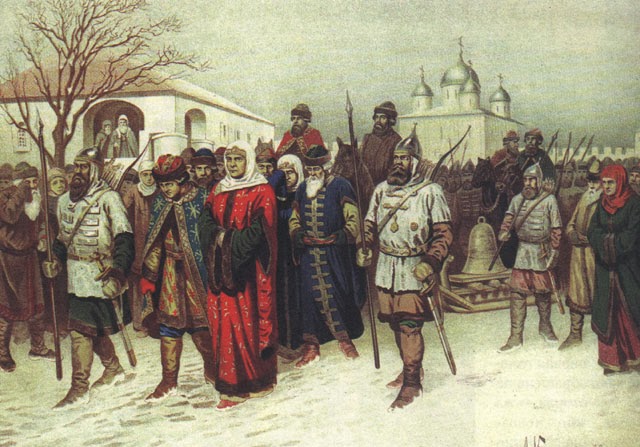
Lost Liberty
Martha the Mayoress by
the Russian painter Alexey Kivshenko (1851-1895). Martha the Mayoress,
was the widow of Novgorod's mayor. According to legend and historical
tradition, she led the republic's struggle against Muscovy between
her husband's death and the city's eventual annexation by Ivan III of
Russia in 1478. After the defeat Martha was escorted to Moscow with
the veche bell the symbol of Novgorod's liberty.
Subscribe to:
Posts (Atom)