Friday, January 3, 2014

Heroic Defense

The Hospitalier Maréchal Guillaume de Clermont defending the walls at the Siege of Acre, 1291, by The French painter Dominique Papety (1815–49). The painting forms part of the over 120 paintings in The Salle des Croisades in the Palace of Versailles. The rooms were created in the mid-19th century by king Louis-Philippe, and opened in 1843, at a time when France was seized with enthusiasm with its historical past, and especially the Crusades period.

Friday, December 27, 2013

Cruel Tradition

Druids offering human sacrifices by the French artist Alphonse de Neuville (1835-1885). This book illustration was done for Guizot's History of France. Neuville studied under Eugène Delacroix and was one of the most famous illustrators of his time.

Saturday, December 21, 2013

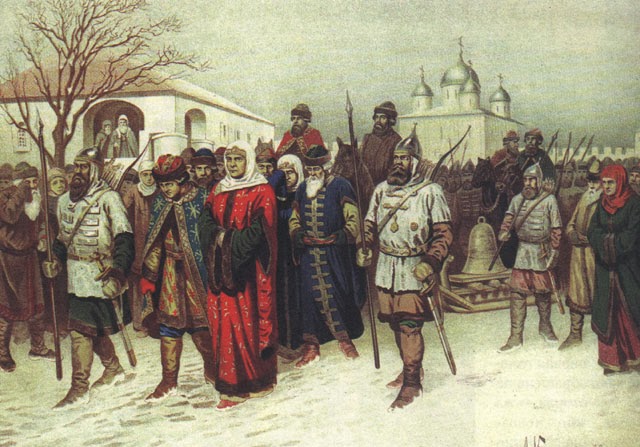
Lost Liberty

Martha the Mayoress by the Russian painter Alexey Kivshenko (1851-1895). Martha the Mayoress, was the widow of Novgorod's mayor. According to legend and historical tradition, she led the republic's struggle against Muscovy between her husband's death and the city's eventual annexation by Ivan III of Russia in 1478. After the defeat Martha was escorted to Moscow with the veche bell the symbol of Novgorod's liberty.

Monday, December 16, 2013

Romantic Death

The Death of Josselin by the Italian painter Massimo Taparelli, marquis d'Azeglio (1798-1866). A legendary crusader is dying in a beautiful exotic land. The landscape is pure fantasy only the palm tree indicates that all this is happening somewhere far far away.

Tuesday, December 10, 2013

Battle Choreography

The Battle of the Lech in 955 by the German painter Michael Echter (1812-1879). To paint as much brave German warriors as possible and to achieve the popular pyramidal choreography Echter put the foot soldiers ahead of the attacking knights which no partly clever commander would have done.

Tuesday, December 3, 2013

Spoils of War

Cromwell in the Battle of Naseby in 1645 (1851) by the English painter Charles Landseer (1799-1879). Lanseer depicted here not the battle action but the victors and the spoils. In front there is a dead women a hint to the over 100 women camp-followers the parliamentarian troops also hacked to death believing they were Irish.

Thursday, November 28, 2013

A Wild Bunch

Lisowczycy by the Polish painter Juliusz Fortunat Kossak (1824-1899). The Lisowczycy were a irregular unit of Polish–Lithuanian light cavalry in the 17th-century . The Lisowczycy took part in many battles across Europe and the historical accounts of the period characterized them as extremely agile, warlike, and bloodthirsty. Their numbers varied with time, from a few hundreds to several thousands. The fought first in Polish wars and later as mercenaries in the Thirty Years War.

Wednesday, November 20, 2013

A Meditative Genius

Michelangelo Visited in His Studio by Pope Julius II (1859) by the French painter Alexandre Cabanel (1823-1889). Here the great genius contemplating his impressive statues visited by the most important patron of arts. What would Cabanel say with that?

Friday, November 15, 2013

Against the Forces of Nature

Snow Storm: Hannibal and His Army Crossing the Alps (1812) by the British painter. Though Turner is mostly considered a landscape painter he did here kind of history painting. At least he mixes both genres. That Hannibal and his army are not simply decoration indicates the date of the painting. Turner saw parallels between Hannibal and Napoleon, and the historic Punic War between Rome and Carthage and the contemporary Napoleonic Wars between Britain and France. So history is important as a looking glass on modern events.

Friday, November 8, 2013

Sugary History

The Landing of William Penn by the American history painter Jean Leon Gerome Ferris (1863-1930). There are a lot of nice (schoolbook) details, all the different costumes, the Native Americans, the trapper, the soldier, dutch settlers etc. There is even the year of the landing on the building.
Though it's sugary, too sweet, more like a costume ball.

Sunday, November 3, 2013

Gentlemens Pleasures

Gentlemens pleasures by the French artist Adolphe Alexandre Lesrel (1839-1929). Another of the typical Lesrel genre paintings. Normally settled in the 17th century where men dresses in Rembrandt costumes have even a better time as on Rembrandt's paintings.

Saturday, October 26, 2013

Somewhere and Somewhen

This exotic scenery is by the Austrian painter Rudolf Ernst (1854-1932). Ernst was a famous orientalist painters and did here something which looks a little historical. But I think it doesn't matter. He was alsways looking fpr the exotic, the strange. So it's more a kindof pre-fantasy painting.